- ▸ Round flow: stake, Run, pick one of three lanes each step, Withdraw before a train hits.
- ▸ Bets run $0.10 to $150; the default demo bet is $1 with 1 / 2 / 5 / 10 chips.
- ▸ A higher lane multiplier is the riskier lane; the low lane is the calmer step.
- ▸ A roughly five-second timer auto-picks a lane if you wait, so decide early.
- ▸ There's a target auto-cashout (x1.10 / x1.50 / x2.00 presets) but no auto-bet - every round is a manual Run.
- ▸ Learn it free in the Chicken Subway demo before staking real money.
Reviewed game
 Chicken Subway (100HP Gaming)
Play the game
18+ | T&C apply | Play responsibly
Chicken Subway is a step-multiplier crash game: a chicken runs subway tracks, and at each step you pick one of three lanes, each showing its own multiplier. Every safe step raises the multiplier, and you cash out before a train ends the round. A 5-second timer auto-selects a lane if you wait. Bets run $0.10 to $150. Here is exactly how a round works.
How a Chicken Subway round works
You set a stake between $0.10 and $150, press Run, and the chicken starts on the centre track. At every step three lanes appear, each showing its own multiplier, and you tap one to move forward; a safe step compounds your running multiplier while a train collision busts the round and takes the stake. You lock the win with the Withdraw button before any crash. The one twist most crash games don't have is the three-lane branching pick each step, layered on a roughly five-second timer that auto-selects a lane if you hesitate.
That's the whole loop. It's chance, not skill: the only decisions are which lane and when to cash out.
Key takeaways
A round, step by step
Here's exactly what happens from the moment you press Run to the moment you cash out or bust. Nothing here needs a manual outside the game itself; the flow is short by design.
1. Set the stake
Choose a bet from $0.10 to $150 using the chips or the number field. The demo defaults to $1 with quick chips of 1, 2, 5 and 10.
2. Press Run
The chicken drops onto the centre track and the first set of three lanes appears ahead. Your multiplier starts near x1.00.
3. Pick a lane
Three lanes, three multipliers - for example x2.20, x3.00 and x6.00. Tap one. The bigger the number, the bigger the risk on that step.
4. Advance or bust
A safe step moves the chicken forward and compounds your total multiplier. A train collision ends the round and the stake is lost.
5. Beat the timer
You get about five seconds each step. Wait too long and the game auto-selects a lane for you, which is rarely the one you'd have chosen.
6. Withdraw
Press Withdraw to lock the current multiplier. Your bet times that multiplier credits to your balance, and the round is over.
The three-lane choice and the five-second timer
This is the part that sets Chicken Subway apart from a linear crash game. Instead of a single advance-or-cashout decision, every step is a spatial pick between left, centre and right, and each lane carries a different multiplier. A high lane pays more per safe step but is likelier to bust.
Reading the lanes
- Low lane - the smallest multiplier, the safest step, the slow build.
- Middle lane - a compromise between reward and risk.
- High lane - the largest multiplier and the highest bust chance.
The timer is the pressure. Roughly five seconds after the lanes appear the game picks for you if you haven't tapped. A cautious player who freezes can be handed a risky lane, so the safest habit is to decide the moment the gates show. This is why we always suggest a lap through the Chicken Subway demo first.
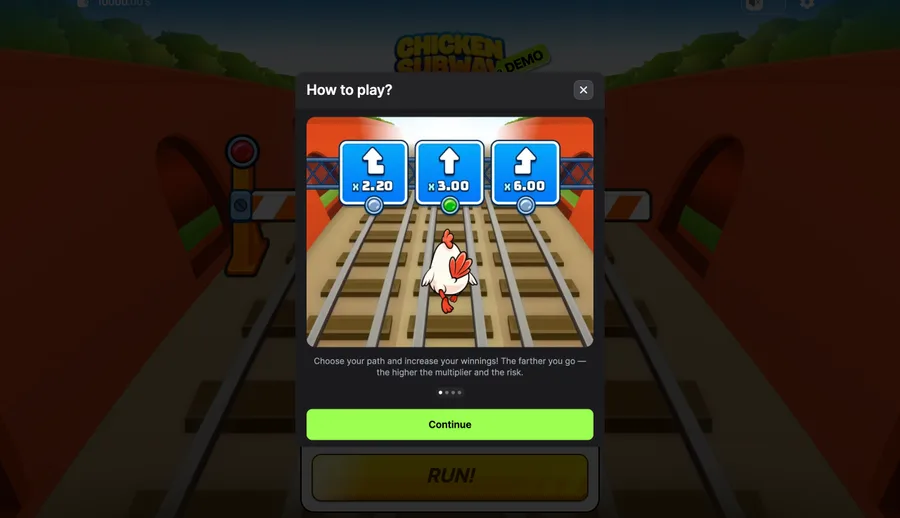
Picking your track under pressure
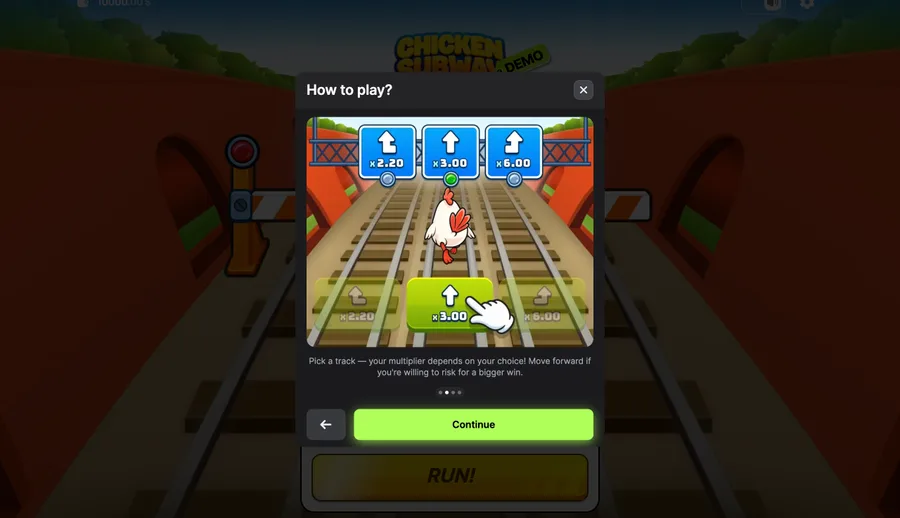
The in-game slide puts it plainly: your multiplier depends on your choice, and every forward step trades safety for a bigger win. There's no correct lane, only a risk level you're comfortable with on that step.
A steady plan is to favour lower lanes early, when your total multiplier is still small, and only reach for a high lane if you've already banked a cushion mentally. But remember the compounding cuts both ways: three safe steps at modest multipliers can beat one greedy jump that busts.
Withdraw and target auto-cashout
Withdraw is the core mechanic. Hit it and the game freezes your current multiplier, multiplies your stake by it, and credits the balance. Miss the moment and a train can wipe the whole round, so cashing out is the only skill-adjacent thing you do.
Auto-cashout, and what's missing
- Target auto-cashout - preset exits at x1.10, x1.50 and x2.00 fire a Withdraw automatically once you reach that multiplier.
- No auto-bet - there's no hands-off autoplay; every single round needs a manual Run.
Target auto-cashout is the most useful setting in the game because it takes the decision out of a tense moment. Set a target you'd be happy with, let it fire, and you sidestep the greed that ends most rounds. For where those targets sit against the odds, see the RTP and max win.
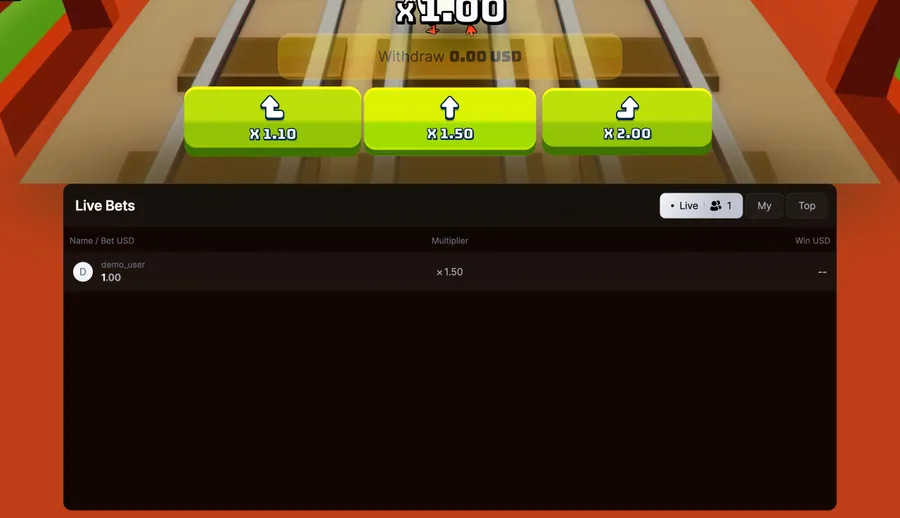
A worked example of the compounding
Say you bet $2 and take three safe steps. The multipliers you land compound, they don't add. Here's how a modest run stacks up against a greedy one, using round example lane values.
| Step | Lane multiplier | Running total | Cash on a $2 bet |
|---|---|---|---|
| 1 | x1.20 | x1.20 | $2.40 |
| 2 | x1.30 | x1.56 | $3.12 |
| 3 | x1.40 | x2.18 | $4.37 |
| Greedy jump | x6.00 (busts) | - | $0.00 |
Three calm steps turned $2 into $4.37. The greedy high lane on step one would have paid more if it survived, but on our demo sample the high lanes busted far more often. This is the whole tension of the game in four rows.
Cash-out discipline, and the predictor lie
There is no strategy that beats the game, only discipline that protects your bankroll. Set a session budget you can lose without a flinch, split it into small stakes, and pick a target multiplier before each round rather than in the heat of it. The target auto-cashout exists precisely so you can commit to that number in advance.
Ignore anything selling a Chicken Subway predictor, signal, hack, pattern or bot. The game is provably fair, each round is independent, and no tool can read a future that hasn't been generated yet; anyone selling one is running a scam, often bundled with a fake Chicken Subway APK. You can verify a round yourself, which we walk through on the is Chicken Subway rigged page. Chicken Subway carries real financial risk, so set limits and never chase a loss.
Honest limitations and when to skip it
The core loop is fun but thin. Chicken Subway is an iterative reskin of the Chicken Road road-cross formula, so if you've played that family the novelty is mostly the extra lane. Sentiment is unproven too: the only structured score sits near 9/10 on just a handful of votes, which is not an endorsement.
The five-second timer can auto-pick a lane against a cautious player, the 98.00% RTP is an operator-configurable headline with no published lower decimals and no named RNG lab certificate, and there are no documented difficulty modes, which is a genuine information gap versus better-mapped rivals. The x55,000 headline multiplier is a mirage against the $10,000 per-round cash cap.
Our named anti-recommendation: if you want a documented multi-mode risk ladder or an aggregator-confirmed provably-fair spec, the original Chicken Road at 98% RTP is the better-documented pick today. See how they compare on games like Chicken Subway, or read the full Chicken Subway review for our overall verdict.
Playing on mobile and where it runs
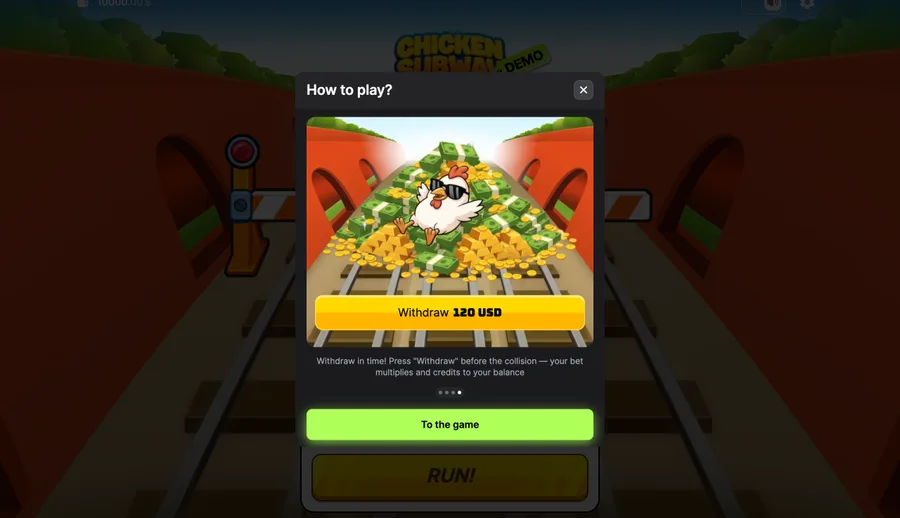
Chicken Subway is an 8.3 MB HTML5 game, so it runs in any modern browser on desktop or phone with nothing to download. The controls are built mobile-first: three big lane buttons and one Withdraw bar, which is exactly what you want when a five-second timer is ticking. We found the touch targets comfortable and the round rhythm identical across devices.
Because it's browser-based, there's no official app to install. Any Chicken Subway APK you find is not from 100HP Gaming, and we cover why to avoid those on the mobile page. At India-facing casinos you deposit in rupees via UPI or Paytm, though the game itself quotes its limits in USD. Availability varies, so search the lobby for 100HP Gaming titles rather than assuming a given operator carries it.
Quick questions on playing Chicken Subway
How many lanes are there each step?
Three: left, centre and right, each with its own multiplier. The chicken starts on the centre track and you tap one lane per step.
Is there autoplay?
There's a target auto-cashout with x1.10, x1.50 and x2.00 presets, but no auto-bet. Every round needs a manual Run.
What happens if I don't pick a lane in time?
After roughly five seconds the game auto-selects a lane for you. It's rarely the safe one, so decide the moment the gates appear.
What's the most I can win in one round?
A hard $10,000 per-round cap. The x55,000 you'll see on some pages is a mirage; the cash cap binds long before that. The RTP and max win page has the detail.