- ▸ RTP is 98.00% by default, above the crash-game average, but operators can configure it downward and no lower decimals are published.
- ▸ The real ceiling is a $10,000 per-round cash cap, not the x55,000 multiplier affiliates quote.
- ▸ House edge is about 2% at the default RTP.
- ▸ Bets span $0.10 to $150; volatility is Medium and you nudge it yourself by which lane you pick.
- ▸ There are no bonus rounds, no free spins and no jackpots to bend the numbers.
Reviewed game
 Chicken Subway (100HP Gaming)
Play the game
18+ | T&C apply | Play responsibly
Chicken Subway runs a 98% RTP with a house edge near 2%. Affiliate copy waves a headline x55,000 multiplier around, but a hard $10,000 per-round cap is the number that actually decides your biggest win. Here is what the maths mean for a real session, and why that cap binds long before the multiplier.
Chicken Subway RTP, max win and the cap that actually matters
Chicken Subway runs a headline 98.00% RTP with a house edge of roughly 2%, and every round is capped at a hard $10,000 payout. That cap is the number you should build your expectations around. When we loaded the free demo, the affiliate-famous x55,000 top multiplier never came close to mattering, because $10,000 binds first at any bet you would sensibly place. Bets run $0.10 to $150, volatility sits at Medium and shifts with your lane choice, and there are no bonus rounds to change the maths. If you want the mechanics behind these figures, read how Chicken Subway works; for the full picture start at our Chicken Subway review.
RTP and max win: key takeaways
What the 98.00% RTP really tells you
Return to player is a long-run average. A 98.00% RTP means that across millions of rounds the game is modelled to pay back 98 cents of every dollar staked, leaving a house edge near 2%. That is genuinely strong for a crash game, where 96% to 97% is more typical, and it edges out siblings like Chicken Road 2 and Rabbit Road that both sit at 95.5%.
Two honest caveats matter here, though. First, 98.00% is the default figure both structured aggregators carry, and operators are free to run a reduced model. No lower decimals are published anywhere, so we cannot tell you what a specific casino serves. Second, RTP is a statistical average, not a promise for your session. On any short run you can lose far more than 2% or win well above it, because variance dominates over a handful of rounds.
We treat 98.00% as a headline, not a guarantee. It is the number to publish, but it does not describe what happens in the next ten rounds you play. If you are checking whether the game is honest at all rather than just profitable, that is a separate question we cover on the is Chicken Subway rigged page.
Multipliers climb, but the payout does not
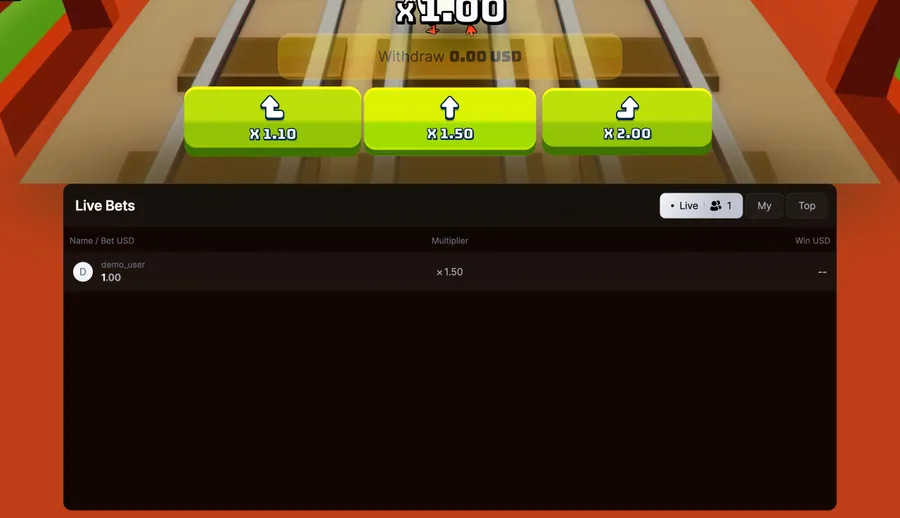
Each safe step compounds your multiplier. The three lanes at every step carry different values, and the higher one is the riskier one, so a run can build fast. What that run cannot do is pay past the cap.
How the multiplier behaves
- The multiplier starts near x1.00 and grows with every advance.
- Picking the high-multiplier lane speeds the climb and raises bust risk.
- Your cash-out locks the current multiplier times your stake.
- Any result above $10,000 is truncated to $10,000.
The max-win truth: why $10,000 beats x55,000
This is the section that matters most, so we will be blunt. Affiliate pages love to wave an x55,000 top multiplier at you. It is a mirage. Chicken Subway pays a hard $10,000 maximum per round, and that cash cap binds long before any headline multiplier could.
Do the arithmetic and it falls apart quickly. To turn x55,000 into real money you would need a multiplier of 55,000 to actually land AND a bet small enough that 55,000 times it stays under the cap. At the demo default of $1, x55,000 would notionally be $55,000, but you would still be paid $10,000. At a $10 bet, the cap is reached by just x1,000. At the $150 maximum bet, the cap is hit at roughly x67. In other words, on any bet worth placing, the payout is limited by dollars, never by the advertised multiplier.
So the x55,000 figure is not a target and it is not achievable cash. We would not chase it. The number to plan around is $10,000 per round, full stop. Anyone framing the multiplier as a route to five or six figures is selling you a headline the game itself overrides.
Chicken Subway maths at a glance
| RTP (default) | 98.00% |
|---|---|
| House edge | ~2% |
| Max win per round | $10,000 (hard cap) |
| Headline top multiplier | x55,000 (unverified mirage; cap binds first) |
| Bet range | $0.10 - $150 |
| Volatility | Medium, adjustable by lane |
| Bonus rounds | None |
| Lanes per step | 3 (Left / Center / Right) |
| Developer | 100HP Gaming |
Volatility is a dial you set yourself
Chicken Subway is rated Medium volatility, but that label undersells how much you control it. The three lanes each step carry different multipliers, and the bigger one is the riskier one. Keep tapping the low lane and you get a slow, low-variance grind with frequent small cash-outs. Reach for the high lane every step and you push toward high-variance swings where busts arrive sooner but the multiplier climbs fast.
That makes the game unusually self-tuning for the genre. A cautious player can effectively run it low; a swing-for-it player can crank it up, all inside one Medium rating. We would not quote a standard-deviation figure, because none is published and inventing one would be dishonest. What we can say from the demo is that the high lane bust us out far more often than the low lane did.
What our demo sample showed
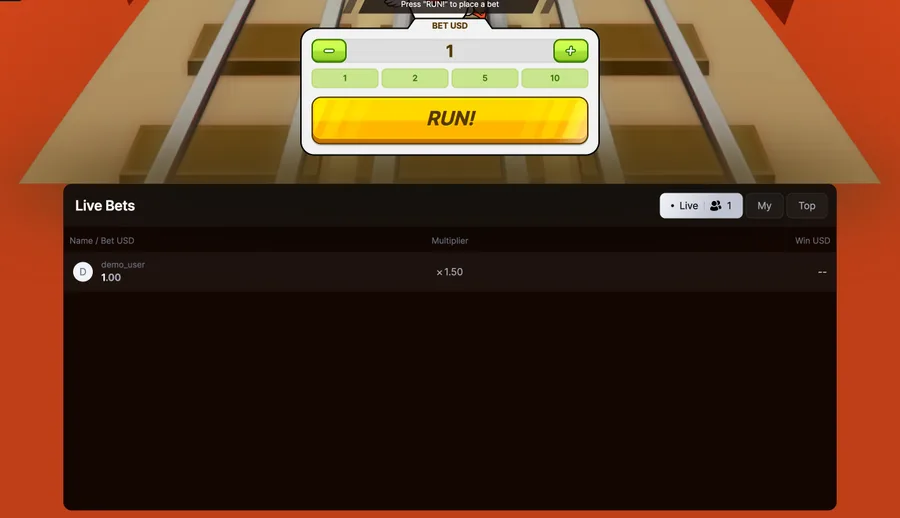
We played the free demo across a short run of rounds, and this was an illustrative sample, not a rigorous test. On that small sample the round ended early more often than not when we chased the high lane. The cautious low-lane approach cashed out more often but at slippery multipliers, mostly under x2.00. Nothing we hit came anywhere near the $10,000 cap, which is exactly the point about the headline multiplier. Try it yourself in the Chicken Subway demo before you ever wager real money.
The honest downsides on the numbers
The 98.00% RTP is a headline, and it comes with real footnotes. It is operator-configurable with no published lower decimals, so a casino can quietly serve less, and there is no named RNG lab certification to back the figure independently. The provably-fair system is real and checkable, but that is a per-round honesty proof, not an audit of the long-run RTP.
Then there is the cap. The $10,000 ceiling makes the x55,000 multiplier a marketing figure with no cash meaning at any sensible bet. There are no bonus rounds to lift a session either, so the maths is what it is.
Our named anti-recommendation: do not chase the x55,000 headline, because the $10,000 cap makes it pointless. And if you specifically want an aggregator-confirmed provably-fair spec and a documented multi-mode risk ladder, Chicken Subway offers neither today; the original Chicken Road (also 98% RTP) is the better-documented pick. You can weigh both on our games like Chicken Subway page.
Bottom line on RTP and max win
The 98.00% RTP is a genuine strength for a crash game and beats several siblings, but treat it as a default that operators can trim, with no third-party audit behind it. Plan every session around the $10,000 cash cap, not the x55,000 headline. Set a target cash-out before you run, keep to the low lane if you want the Medium rating to feel low, and remember variance rules the short term. Carrying real money into this game means real financial risk, so set limits first.